

You're probably hiring for the wrong kind of CSM
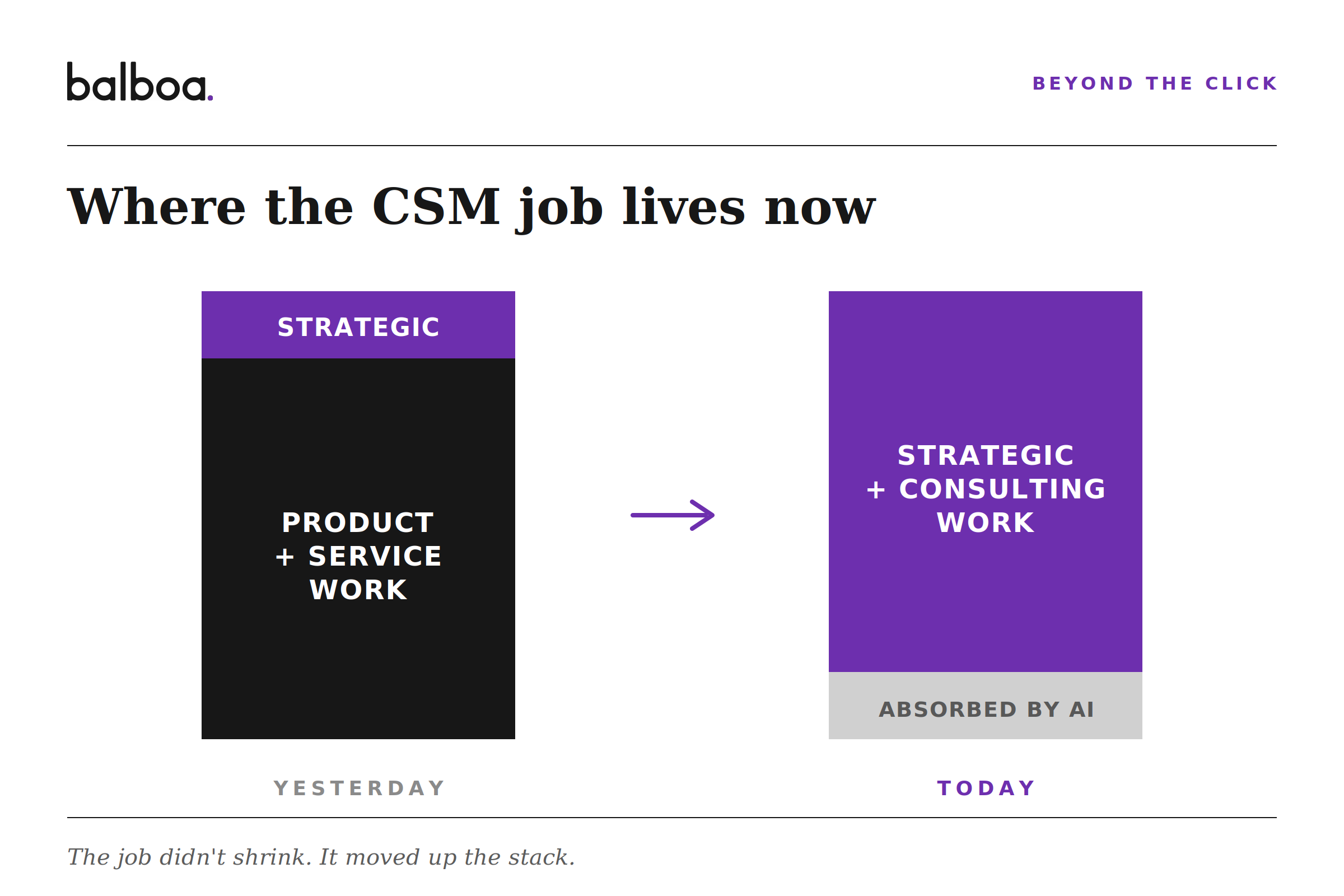
Something fundamental is changing fast underneath the customer success manager role. AI is absorbing the tactical tier of the work faster than most teams expected. The work that’s left behind is harder, more strategic, and demands a different kind of hire. Leaders who keep running their existing interview loops are going to spend the next two years wondering why their new CSMs aren’t landing.
Welcome to Beyond The Click by Balboa. We’ve written before about how the CSM role is shifting from product expertise toward enterprise consulting. Today, we’re breaking down what that actually means for hiring:
- The interview process is no longer effective 📋
- The four signals that matter now 📶
- Questions that surface consulting instincts 💬
- What to do with your current team 👨🎓
Let’s dive in.
The interview process is no longer effective 📋
Most CS interview processes were built to screen for product aptitude, customer-facing polish, and the ability to manage a book of business. Those skills are still essential, but they no longer separate the strong candidates from the weak ones. AI is rapidly absorbing the technical knowledge, which means a candidate who interviews well on “tell me how you’d onboard this customer” is showing you a skill that increasingly has a software substitute.
The leaders we talk to are recalibrating. What they’re looking for now is harder to assess in a one-hour panel, but it’s also what determines whether a hire will be successful 18 months down the road.
The four signals that matter now 📶
Across the conversations we’ve had with AI-forward CS leaders, four signals come up repeatedly:
Industry fluency over product fluency. Can the candidate speak to the strategic pressures inside the customer’s business? Why a CFO at a mid-market bank cares about a specific metric, or what keeps a VP of Engineering at a large enterprise up at night.
Comfort with ambiguity and experimentation. The teams winning right now run two-week experiments, fail fast, and pivot. Candidates who need a defined playbook will struggle.
Hands-on AI usage. Not “I’ve used ChatGPT,” but evidence the candidate has actively built something useful, automated something tedious, or changed how they work. This is the single fastest-moving signal, and it’s a good proxy for adaptability.
Outcome orientation. Can they describe past wins in terms of customer business results rather than just activities completed?
Questions that surface consulting instincts 💬
A few prompts we’ve seen work well, replacing the standard “walk me through a difficult renewal” question:
- “Tell me about a time you changed a customer’s mind about what they actually needed.”
- “What’s an AI tool or workflow you’ve built or adopted in the last six months, and what did it replace?”
- “If you had to walk into a QBR tomorrow with no prep deck, what would you ask the customer in the first ten minutes?”
The pattern across these is that they’re hard to fake and hard for AI to coach a candidate through. They surface judgment, curiosity, and whether the person actually thinks like a consultant or just talks like one.
What to do with your current team 👨🎓
Most leaders aren’t building a CS org from scratch, but they are trying to evolve the one they have. Three moves we see working today:
- Use these same signals to assess your existing team. Not to manage people out, but to identify who’s already operating at the new bar and put them in front of senior leadership.
- Let early adopters on your team teach peers. Top-down enablement is slower and less credible than seeing a colleague do it.
- Get hands-on with the tools yourself, so you can recognize the difference between a candidate who’s actually building with AI and one who’s narrating buzzwords.
The hires you make in the next two cycles will define what your CS team looks like when the rest of the market catches up. The bar is moving, and the interview loop is where that starts.
Was this article helpful to you? Subscribe to Beyond The Click and get the latest on Product Success in your inbox every other Thursday.