

Your Product Usage Data Isn't In the Right Hands
Your product analytics platform knows which customers are about to churn. Your account management team does not. That gap, between the system that has the signal and the people who need to act on it, is one of the most common (and expensive) blind spots in the revenue lifecycle for product companies today.
Welcome to Beyond The Click by Balboa. We just published our how-to guide on Getting Product Usage Data to the People Who Need It Most. Today’s newsletter explores the “why” behind this guide, including:
- The people closest to renewal are working blind 👀
- Retention is now a data distribution problem 📦
- By the time signal arrives, the window has closed 🏚️
- The fix is architectural, not behavioral 📐
Let’s dive in.
The people closest to renewal are working blind 👀
Account managers and CS teams own the customer relationship. They know which accounts are coming up for renewal, which ones have been escalating, and which executives are growing cold on the product. What they typically do not know is whether those accounts actually used the product last month.
That signal lives in a system they rarely open, maintained by a team with different priorities, and it almost never makes it into the CRM before a renewal conversation starts. Most revenue teams are navigating retention on relationship history, gut feel, and whatever made it into the notes. This system has lots of cracks and doesn’t scale.
Retention is now a data distribution problem 📦
The leading indicator of churn is not a missed QBR or a support ticket spike. For most B2B SaaS companies, it is in-product behavior. A customer who goes dark for 60 days is telling you something, but can anyone on your revenue team hear it in time to do something about it?
Most cannot. Not because the data doesn’t exist, but because it never reaches them in the workflow where they are making decisions. The data problem is largely solved, but the distribution problem is far from it.
By the time signal arrives, the window has closed 🏚️
Enterprise procurement cycles are long. Budgets get locked early. A customer who stopped adopting a key feature in Q2 may already be building the internal case for cancellation by Q3, long before your team registers any risk at all. And the pattern is usually gradual, not dramatic. It looks like a power user who stopped logging in. A workflow that got purchased and never deployed. A team that shrank its active user count by a third without ever filing a support ticket.
Proactive retention requires catching that drift early, and early means automated, continuous, and tied directly into how your team works. Not depending on someone remembering to check a dashboard.
The fix is architectural, not behavioral 📐
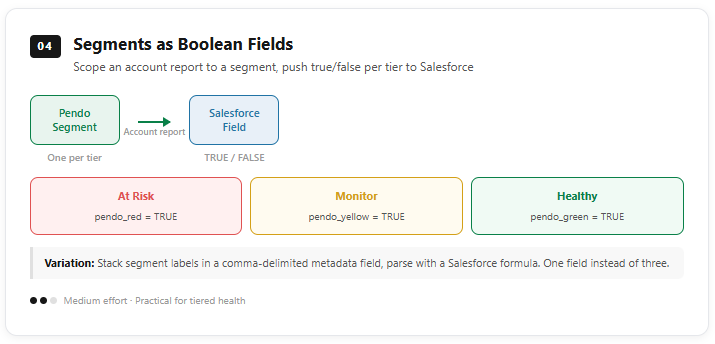
Telling a CS team to log into Pendo before every customer conversation doesn’t work. The habit is too entrenched and the ask is too easy to skip. The data has to meet your revenue team where they already live. That means routing the right product signals into Salesforce in a form that is actually useful: not raw event counts, but rather health indicators, usage summaries, risk flags, and recommended next actions sitting directly on the account record. The goal is an account manager who opens a renewal opportunity and already knows where the customer stands before the call begins.
There are several ways to get there, and they vary considerably in complexity and capability. That’s why we broke down the six main methods in detail so you can figure out which one fits where your team is today.
Was this article helpful to you? Subscribe to Beyond The Click and get the latest on Product Success in your inbox every other Thursday.