

How to keep the customers you already have
Most companies are losing customers they had every reason to keep. The effort is there, and the people are good, but what’s missing is the architecture to support them.
Welcome to Beyond The Click by Balboa. We recently published a field guide with our friends over at Pendo on how to build a predictive revenue retention motion. Today we’re covering the reasons why you should even care about predictive retention, including:
- The signals are in the building 🏢
- From a dozen attributes to single score 📊
- Your data warehouse is the easy button 🗄️
- The math just makes cents ➗
Let’s dive in.
The signals are in the building 🏢
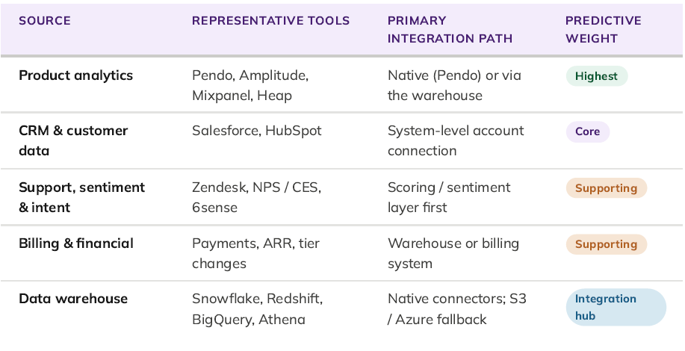
Everything you need to predict whether a customer renews, expands, or cancels already exists inside your business. It sits scattered across product analytics, the CRM, support systems, and billing records. Product usage tells you how engaged someone is. The CRM tells you who they are and what they pay. Support tickets tell you what they struggle with. But the problem is that turning those scattered signals into a decision falls to individual people, account by account, working on instinct.
That doesn’t scale, no matter how good the people are. A June 2026 RepVue report found that nearly half of customer success managers in the United States miss their annual target. When the number gets that high, the role itself is misaligned with reality.
From a dozen attributes to single score 📊
Consider an alternative. Instead of each of your people weighing a dozen attributes one at a time, a single model ingests every signal you have, learns from your own history of churn and renewal, and produces one continuously updated read on each account, with the reasoning attached.
Think of it like an expert analyst who has reviewed every account you have ever lost and can now look at any current customer and tell you whether it’s on the same path. It doesn’t forget anything, it refreshes its read every night, and it runs on data instead of gut feel. The model handles the synthesis while the human does the judgment and the work. And the synthesis lands where the team already operates, which is inside the CRM record, explained in plain language, and paired with a recommended next step. The CRM stays the system of record. The model becomes the brain sitting on top of it.
Your data warehouse is the easy button 🗄️
A model like this is only as good as the data feeding it, and for most companies the cleanest place to blend all those sources is the data warehouse. It gives you one normalized view across product usage, CRM, support, and billing, which beats stitching direct connections one by one and holds up better as the program grows.
Getting product usage into that warehouse used to be the hard part. Pendo just closed that gap with native Data Sync to Snowflake, which lands behavioral data in the warehouse with no ETL and no engineering lift. That’s just one less excuse for companies not to maintain a full picture of their customers.
The math just makes cents ➗
The ROI on predictive retention is concrete. For example, in a $50 million ARR business, catching three out of four at-risk accounts instead of just one out of four pulls your gross churn from 15% down to 5%, worth about $5M saved. The same engine that flags risk also flags potential expansion, and acting on that early can lift net revenue retention from 105% to 115%, adding another $5M in net new ARR. Ten million dollars of swing, from data you already have sitting in your stack.
The data is already yours. Putting it to work is now a question of architecture, not headcount. If you want to learn how, read the full whitepaper here, no email required.
Was this article helpful to you? Subscribe to Beyond The Click and get the latest on Product Success in your inbox every other Thursday.