

Validation debt is the new tech debt

Every engineering leader knows tech debt. The time borrowed through an architecture shortcut, taken to hit a deadline, that ultimately gets repaid (with interest) years later when the product breaks. Product teams have their own version of this, and thanks to AI coding, it’s getting bigger every day.
What if you shipped a feature last quarter, but nobody checked whether it’s getting used because your team already moved on to the next request from sales? That’s how you get validation debt, aka the compounding pile of features that were built but never proven to matter. With tech debt, the bill arrives as refactors and outages. But with validation debt, the bill comes as flat adoption, lost renewals, and a bloated roadmap.
Validation debt predates AI, but the scarcity of engineering resources used to naturally control it. Now that a single person with a coding agent can build almost anything, that safeguard is gone. Today, the only thing that separates an effective product org from a “feature factory” is the discipline to validate before building.
Welcome to Beyond The Click by Balboa. Today we’re covering three practices that pay down validation debt before you hit bankruptcy, including:
- Run discovery several sprints ahead 🏅
- Fill all the seats at the table 👨💻
- Don’t sacrifice your agility ⚽
Let’s dive in.
Run discovery several sprints ahead 🏅
The dual-track product dev model has been around for a while. This is where discovery and delivery run in parallel, discovery feeding validated work into the backlog. We’d like to say that model is now table stakes, but frankly it’s just insufficient.
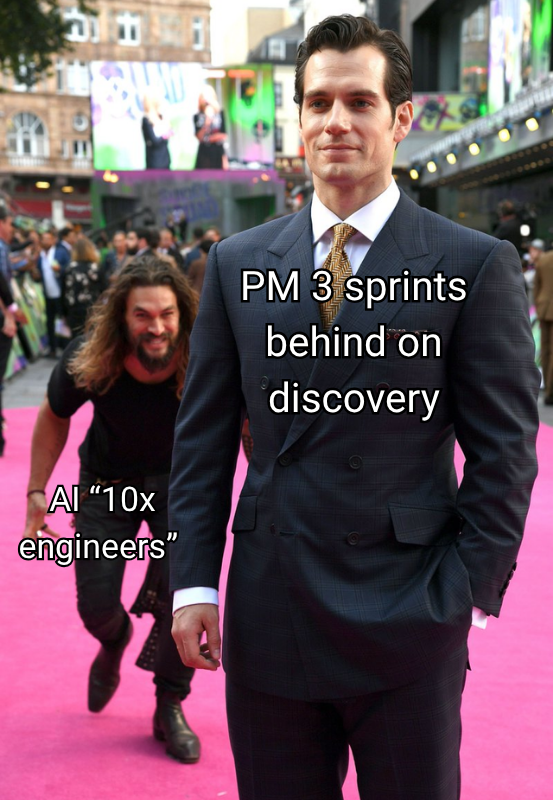
Because AI-powered engineering can move so fast, discovery now has to be ahead by multiple sprints, or the dev team runs out of validated work and starts building on a guess.
Sure, AI-powered discovery is also a thing. Connect a few years of discovery call transcripts and product analytics data into your AI workspace via MCP, and you’re much less behind than you were. But most of the gap can only be closed through discipline, not tools.
This discipline means putting every idea through a sequence of risk-reduction steps. Thirty-minute discovery calls with users find the pain point as they experience it. Next, high-fidelity, clickable prototypes test whether the idea solves that pain. Only then does the idea move to engineering’s backlog. But validation continues post-launch too, because you need product analytics to see the gap between what users said and what they actually do.
Fill all the seats at the table 👨💻
Getting engineers into discovery used to be hard because of all the build work, but the newly freed capacity on that side makes this practical for once.
The Product Triad is PM + designer + lead engineer. Together, they keep four questions in front of every decision:
- Is it valuable?
- Is it usable?
- Is it feasible?
- Is it viable?
The role boundaries can blur (aka PMs prototyping or engineers shaping UX) as long as someone owns each function and everyone is aligned on the problem being solved. But remember that, since each role sees the problem through a different lens, dropping any one of them lets slop through.
Don’t sacrifice your agility ⚽
The tendency when you emphasize product validation is to forget to ship simple. Even good launches fall prey to “death by edge case.” Draw a hard line at the simple version, ship it, and then earn the right to build the full platform later.
Remember that if the first version doesn’t embarrass you just a little, you waited too long. “I like this, but I need more of that” is very healthy customer feedback.
And when shipping simple, resist the AI-fueled urge to “always build, never buy.” Nobody should re-build their own SMS platform or payment processing when mature vendors like Twilio or Stripe can just plug in today (and won’t break tomorrow). Renting infrastructure keeps your team’s scarce attention on validating the things that matter.
And really, the only thing that matters to your customer is if your product a.) drives revenue, b.) keeps revenue, or c.) cuts cost.
That is the whole point. We aren’t here to do Agile, or Scrum, or even AI. We’re here to drive customer outcomes, and shipping is just a part of that.
Was this article helpful to you? Subscribe to Beyond The Click and get the latest on Product Success in your inbox every other Thursday.