

"Trust But Verify" Works on CSMs AND on Health Scores
Most Customer Success leaders we talk to have a similar problem. Even if they’re invested in health scores, predictive models, and dashboards, the team still runs on gut feel. The data sits in one system, the decisions get made in another, and nobody is quite sure which one to trust when they disagree. One answer to this problem is to run a tight, regular horizon forecast.
Welcome to Beyond The Click by Balboa. We recently hosted Vikas Sharma and Kelly Causey from Emburse for a DX Roundtable on moving CX from reactive to predictive. Their horizon forecast was a key piece of the operating model, and today we’re breaking down why it works:
- The ritual that keeps everyone honest ☕
- When the score and the CSM disagree ⚔️
- Why everybody else wants in 👌
Let’s dive in.
The ritual that keeps everyone honest ☕
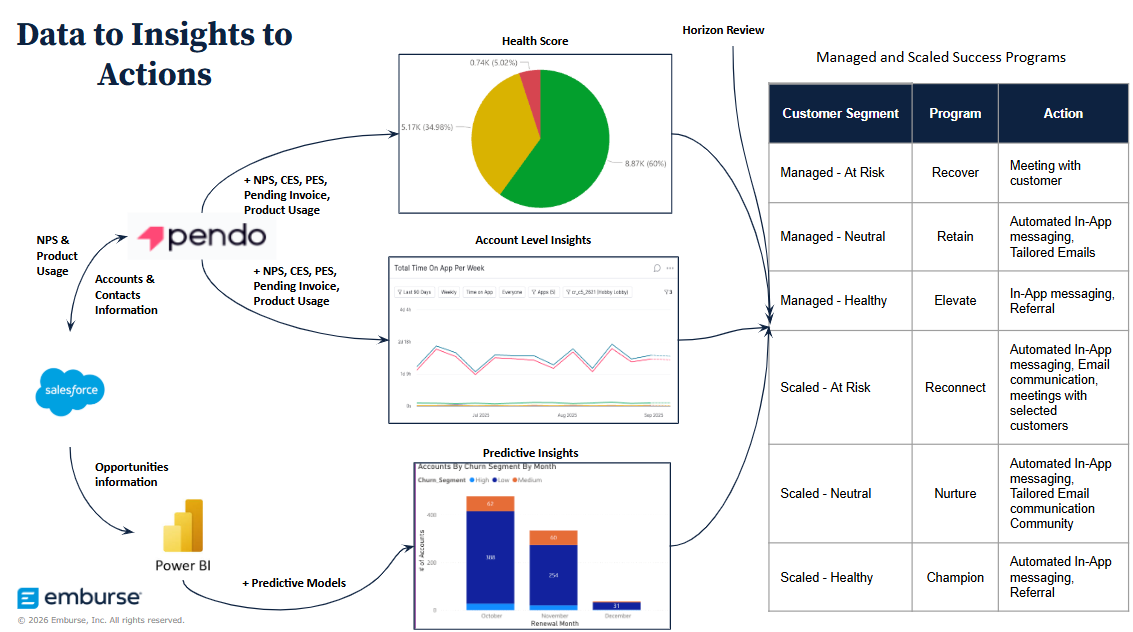
Once a month, the Emburse CS team runs a “horizon forecast” covering every account up for renewal in the next 180 days. CSMs come in having touched the data themselves, not just glancing at a dashboard. They present their read on each account, the signals they’re seeing, and where they think the risk sits.
What makes it work is what happens in parallel. While the CSM is presenting, the leaders are pulling up the health score on the same account. The intelligence layer and the human layer are both in the room at the same time, looking at the same customer. The point isn’t to catch the CSM off-guard, but rather to put both inputs side by side and see whether they agree.
When the score and the CSM disagree ⚔️
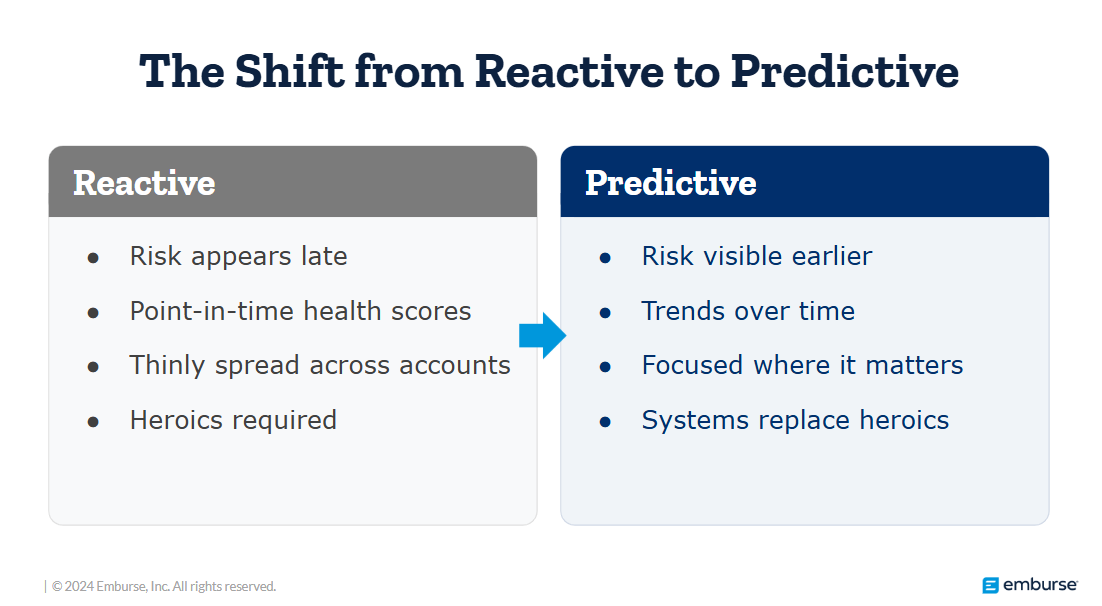
The interesting moments are the disagreements. When a CSM says an account is green and the system says red, one of two things happens. Either 1.) CS Ops finds a new insight that needs to be added to the health score model, or 2.) the CSM gets a calibration on their intuition.
In the 1st scenario, it could be a friction point earlier in the customer journey that the score isn’t reaching back far enough to catch, or a signal the team has been measuring informally that deserves to be ingested formally. Just something the CSM is picking up that the data doesn’t yet capture. The score evolves because the disagreements force it to.
In the 2nd scenario, Kelly described situations where CSMs were pouring energy into lower-value accounts flagged as at-risk while missing a smoke signal on a much bigger one. The horizon forecast surfaces those misallocations early, before they show up in a renewal conversation that’s already gone sideways.
Both outcomes are valuable. The first improves the model, while the second improves the team. And over time, the gap between the two narrows, which is the actual goal. Kelly described it as a team effort between insights and the humans running the accounts, with both staying in check based on what the business is learning in real time.
This is the part most teams miss. A health score that nobody pressure-tests becomes wallpaper. A CSM intuition that nobody pressure-tests becomes folklore. The horizon forecast forces them to hash it out.
Why everybody else wants in 👌
The unexpected outcome at Emburse is who shows up to these forecasts. The early sessions were just the CSMs with accounts on the docket, but now CSMs without any accounts up for renewal come just to listen and learn. Sales reps also show up, plus renewal managers and even support team members. None of these people have a stake in the specific accounts being reviewed, but they want to understand how churn risk is being handled across the business.
That’s a culture shift. When forecasting becomes a place where the organization sharpens its judgment together, it stops being a tax on the CS team and starts being one of the most valuable cross-functional rituals in the business. The customer data becomes shared context, not just CS context, and the conversation about retention starts to sound like a conversation about the company.
If your forecasting process feels like a fire drill that nobody wants to attend, the horizon forecast might be a useful idea to steal.
Was this article helpful to you? Subscribe to Beyond The Click and get the latest on Product Success in your inbox every other Thursday.