

The future of product management
In product analytics, usage has always been a proxy for value. Page views, feature adoption, funnels, and the rest existed to answer two questions:
- “Are the users getting value?”
- “Will the customer stick?”
That worked for two decades because the value showed up as clicks, but today it increasingly doesn’t. A growing share of the value a product delivers now happens inside an AI chat window or through an agent working on a customer’s behalf. If your usage tracking doesn’t work there, you lose your clearest signal on the state of the customer.
Welcome to Beyond The Click by Balboa. We’re launching a new series on the future of product management, and today we’re going deep on AI and agent analytics, including:
- Conventional analytics aren’t enough anymore 🚧
- How AI analytics are different 🤖
- Which metrics matter most now 📊
- What top product leaders are changing today 🧭
Let’s dive in.
Conventional analytics aren’t enough anymore 🚧
“I’m not using our HubSpot anymore. I’m not using Apollo. I’m not using Salesloft, either. My agents are.” This is something a business leader told us this week, referring to platforms he spent thousands of dollars on per month. His value from these products was still high, but his usage had completely changed.
Your customers are probably saying the same thing about your product today.
Conventional analytics assume a human is the one clicking. When a customer’s agent does the work instead, e.g. by calling your product through an MCP server, none of it shows up as a page view or a session, and your dashboard reports nothing. The customer could be getting more value than ever. Or none at all! But you’ve got no way to tell.
How AI analytics are different 🤖
Two AI features can log the identical usage number and mean opposite things. Our own team recently tested an AI assistant that, when asked to help build a workflow, told the user to go read an article instead. On a different tool, the “AI” feature amounted to a button that scanned the page and summarized it back. Both would count as “AI feature used,” but neither delivered anything worth renewing over.
Real agent usage looks different. Instead of a session with a start and an end, it’s a stream of individual interactions, each one a small transaction where the agent actually did something, with a real dollar cost in tokens attached. A feature-use counter can’t tell AI theater from value. But your analytics need to.
Which metrics matter most now 📊
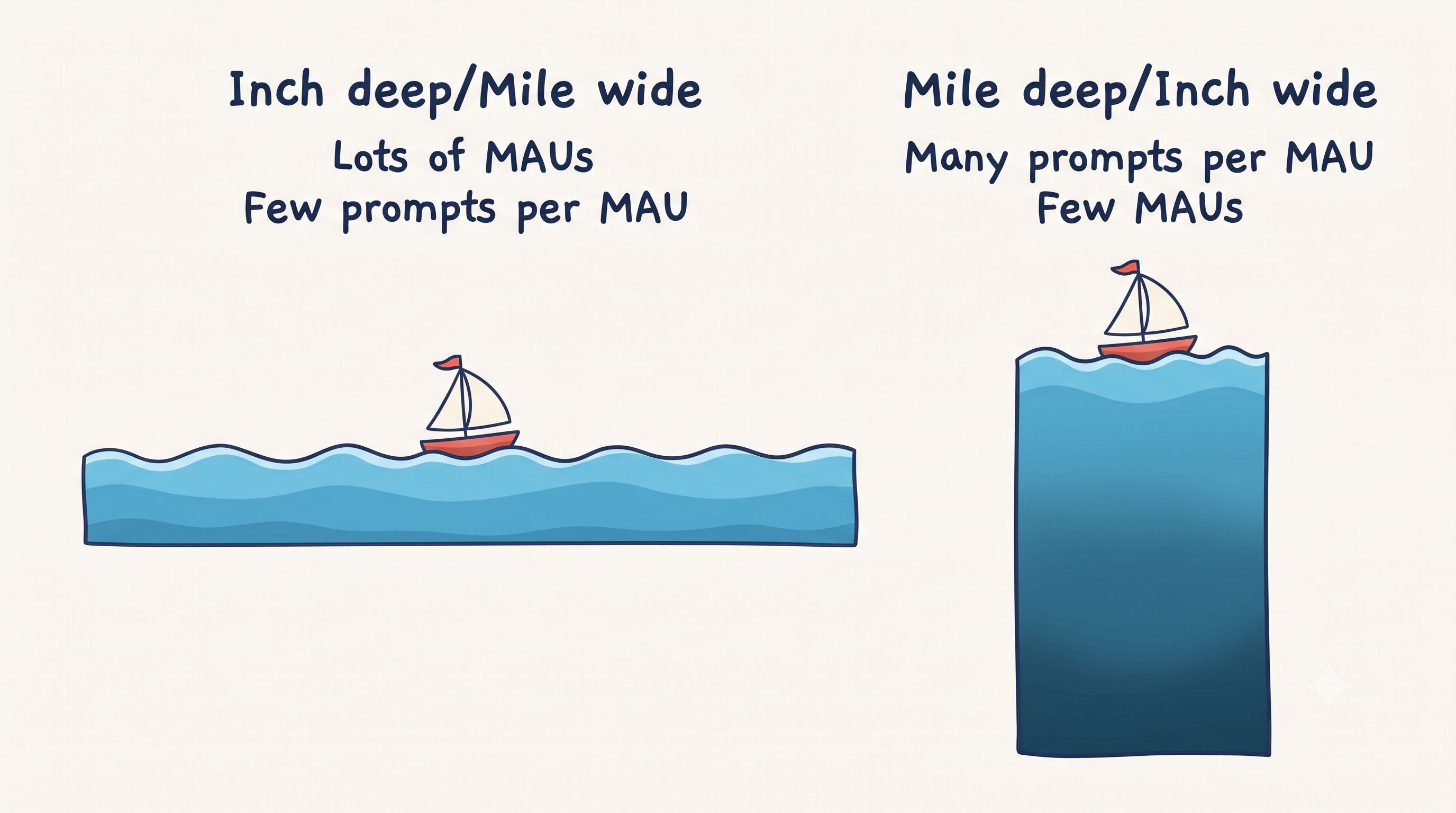
Conventional product metrics like Monthly Active Users (MAU) don’t cut it anymore. A 2026 product analytics report found that North American AI products have high raw user counts but low stickiness, with just 21% of users showing up on a given day. MAU alone doesn’t catch that.
That’s the case for tracking both sides. MAU tells you reach, i.e. how many people are showing up. But interaction metrics tell you whether the people showing up are getting anything done. This includes metrics like prompts submitted and sessions per user. A huge MAU number can sit on top of a hollow product, while a modest MAU number can hide a handful of users getting real value. Track only one side and you can’t tell which.
And a great metric for agent-specific features is autonomy rate, the share of tasks an agent resolves start-to-finish without human involvement. It’s the closest thing agents have to a value signal, as it separates doing the work from just narrating it.
What top product leaders are changing today 🧭
The leaders on top of this change aren’t waiting for their analytics platform to ship a native agent report. They’re tagging these events themselves right now, because every week spent waiting is a week of blind churn risk.
Clicks and page views still matter. They just stopped being where the whole story lives. The question was never about usage. It’s about the state of the customer, and that state is increasingly written somewhere your old dashboard can’t read.
Was this article helpful to you? Subscribe to Beyond The Click and get the latest on Product Success in your inbox every other Thursday.